

When Hamish Blake held up the coveted “Golden Brick” in the hit new TV Lego Masters he described the power of the yellow brick as something that all the contestants would be aspiring to because it would give them special powers and privileges, in particular immunity. Blake then, with his classic comedic grin looks straight at everyone and says “This is an idea we thought of all on our own and it has never been done on TV before.”
What we know is that Blake was shamelessly and humorously going public that the Golden Brick is the equivalent to the rival channel Master Chef’s immunity pin. In fact the entire Lego Masters show is conceptually the same, even structurally the same. Large preparation area, big (lego) door full of the ingredients required to imagine and concoct the Lego creations that will delight the judges. And we love it. The show debuted with 1.377 million viewers beating rival Channel Seven My Kitchen Rules Finale!
And, it’s the Master Chef concept dressed up as Lego Masters.
Hamish Blake makes no effort to hide it or hide the fact that he is new to the prime time hosting role. Regularly saying things the audience or contestants are thinking, keeping it real, light and nailing the PG rating, and the families are lining up to watch it.
It’s NOT a new concept. It’s not a new shape for a reality style competition TV. It’s in fact so blatantly close to the shape of Master Chef that the familiarity actually helps (Yes, I have a nine year old in the house who is an aspiring baker and who loves her Master Chef sessions:))
Innovation is often considered the elusive silver bullet of life and leadership. Absolutely there is a place for breakthrough ideas and new technologies changing the game in quantum ways but often we can take an adaptive approach to innovation and still make significant progress over time.
Innovation can be adaptation before it is reinvention. Not EVERYTHING you are doing is terrible and needs to stop. Some of it just needs to be tweaked, repurposed, updated and maybe just freshened up.
The Newton preceded the iPad. The Jetsons had flat screen TV’s and the original mobile phone was literally like carrying a brick around. The phone is still here, but far less a phone and far more a device to get on with life.
The Innovation/Adaptation Model looks like this:
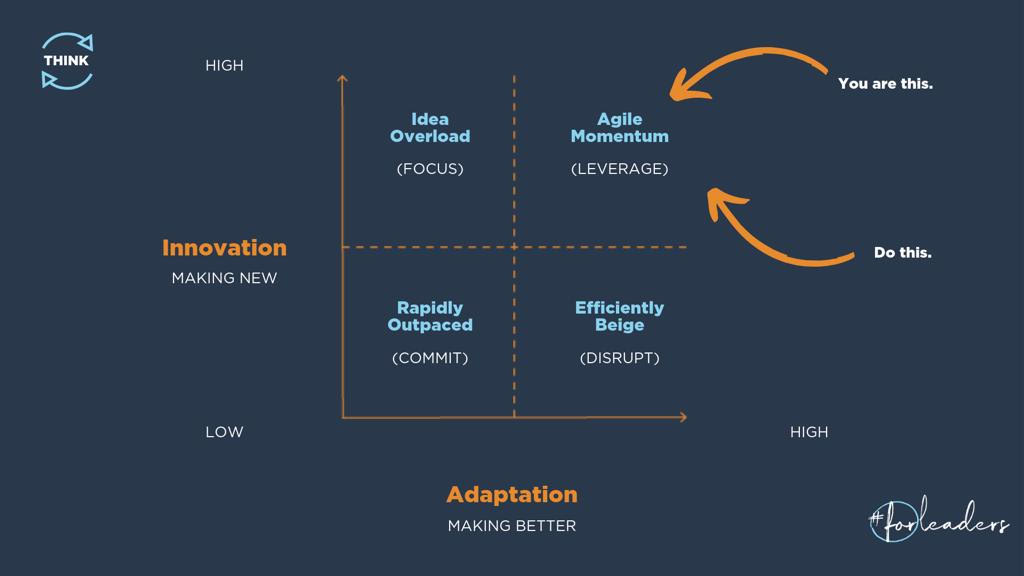
- You are being rapidly outpaced when you have low innovation and low adaptation. The end is near whether you know it or not.
- You are in idea overload if you are high on innovation and low on adaptation. Your people can’t keep up with all the shiny objects that are flying around that need attention paid to them.
- You are efficiently beige if you have low innovation and high adaptation. You are in a rut but it still feels like progress to you.
- You have agile momentum if you have both high innovation and high adaptation. You can ideate and execute fast on the things that will impact the market the most.
On the Innovation management site there are numerous articles investigating the virtues of thinking creatively about the future.The workplace is looking leveraged ways to incorporate innovation in your workplace is a priority for leaders right now. Itai Green’s article proposes that the “Gospel of 2019 Agenda” IS innovation. The way to get that done is less in house and more B2B and collaborative partnerships.
Green says, “In recent years organizations have come to realize that the real, groundbreaking innovation which will save them from ending up like Nokia comes from outside of the organization. Where does it come from? From startups, academia and partnerships with other corporations. The professional term is “corporate open innovation” – as opposed to innovation from within. More and more corporations are realizing that the rate of technological change is so fast that in-house entities can’t keep up. The understanding is that even if company employees are gifted in their fields, there are more, faster, and more creative brains out there and if the corporation wants to survive it has to work with them.”
Essentially, working collaboratively IS working innovatively and we need to be more open, more willing and more ready to create the future together.
How can leaders get innovation by adapting? Here are five ideas:
- Think cross functionally and cross industry for opportunities, leverage and insights when it comes to improving what you are already doing.
- When you’re being outpaced you need to commit to a course of action that changes fast and renews quickly.
- When you’re in idea overload you need to focus fast and deacons on the 1-5 things that will solve the biggest problems, add the most value and serve your target market.
- When you are efficiently beige it’s time to disrupt the status quo, add colour and shade. End the program that died long ago and invest into that which will revitalise.
- When you have agile momentum think leverage. How can we continue to ideate and execute in a way that will give us deeper positioning and market share? What are our ace offerings and how can more people access them?
What’s interesting is despite knowing what a blatant copy the Lego Masters concept is, it remains inspiring to sit alongside my nearly seven year old and hear him gasp with joy at what he’s seeing. It didn’t take much to reshape the idea but boy did it work.
#FORLEADERS
This is for leaders. I am for leaders.


Leave A Comment